China Top BIA Analyzers How Do They Calculate Body Fat?

Time:2026-09-28 Author:Sophia
0%

China’s top BIA analyzers estimate body fat by turning a brief electrical measurement into a model of body composition. The process is indirect. A person stands barefoot on metal electrodes, or holds contact handles, while a low-level current passes through the body. The device measures impedance: resistance and reactance to that current.

Water-rich lean tissue conducts electricity more readily than fat tissue. The analyzer combines impedance with details such as height, weight, age, and sex. Its software then estimates total body water and fat-free mass, before calculating body fat as a proportion of body weight. As clinical nutrition researcher Ursula G. Kyle and colleagues describe BIA, “a simple, noninvasive, and relatively inexpensive method for the assessment of body composition.” That description captures the convenience, not every limitation.

So, how does bioelectrical impedance analysis calculate body fat? It uses electrical measurements and prediction equations; it does not directly see or weigh fat. The exact equations can differ among brands and models, so two analyzers may report different results for the same person. Hydration, a recent meal, exercise, and even wet feet can shift a reading. Small details matter.

For a fair comparison, measure under similar conditions each time. Use the same analyzer, at a similar time of day, with dry skin and a consistent routine. Treat the number as an estimate, not a verdict. Even a polished screen can make uncertainty look more precise than it is.
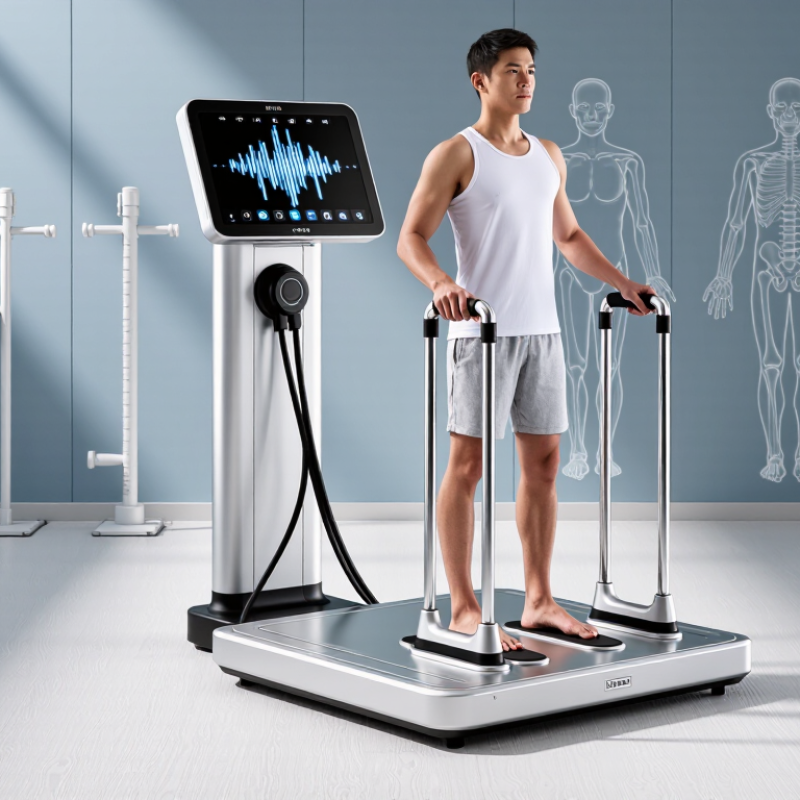
China Top BIA Analyzers How Do They Calculate Body Fat?

How Chinese BIA Analyzers Measure Resistance and Reactance at 50 kHz

At 50 kHz, a BIA analyzer sends a very small electrical current through the body and measures how tissue responds. The current is usually imperceptible. Water and dissolved electrolytes conduct it, while cell membranes influence its path. Two readings matter: resistance and reactance.

Resistance describes opposition to current flow. Reactance reflects the temporary energy storage caused largely by cell membranes. Together, these values form impedance, which the analyzer uses in equations to estimate body water and fat-free mass. The device does not directly see fat. It infers body composition using the readings, along with details such as height, weight, age, and sex.

Small changes matter. A person tested after exercise may have different fluid distribution than during a rested morning measurement. Skin temperature, electrode contact, and recent meals can also shift readings. Consistent conditions help make repeated measurements more useful. Still, a 50 kHz result is an estimate, not a photograph of the body. That distinction is easy to overlook. I would treat trends as more informative than a single decimal point, especially when hydration or routine has changed.

From Impedance to Total Body Water: Using Height²/Resistance Models

A BIA analyzer sends a tiny alternating current through the body and measures resistance. Water-rich tissues conduct electricity better than fat tissue. Many systems use height squared divided by resistance, often written H²/R, to estimate conductive body volume. That estimate helps infer total body water (TBW). Equations then translate TBW into fat-free mass, based on assumptions about the water content of lean tissue. Body fat percentage is calculated using this estimate alongside body weight. An analyzer does not see fat directly.

Real measurements are less tidy. Hydration shifts, recent exercise, meals, and skin temperature can affect resistance. Even damp feet may change contact with the electrodes. Depending on the device, age, sex, and weight may also enter the equation. For more comparable readings, measure at a similar time, with clean, dry skin, after using the restroom. These are estimates, not fixed truths. A single number deserves caution; the model is useful, but not magic. Height²/resistance is one input, and its accuracy depends on the assumptions and conditions behind the reading.

China Top BIA Analyzers: How Do They Calculate Body Fat? — From Impedance to Total Body Water: Using Height²/Resistance Models

Stage or Measure What Is Measured or Calculated How It Is Used Important Considerations
Electrical impedance A small alternating current is passed through the body. Impedance (Z), measured in ohms (Ω), describes opposition to that current. It includes resistance (R) and reactance (Xc). Impedance provides an electrical measurement that can be used with body measurements and a prediction equation to estimate body water or fat-free mass. Impedance is not a direct measurement of body fat. Results depend on measurement setup, current frequency, electrode configuration, and the equation used.
Resistance (R) Resistance, measured in ohms, primarily reflects the conductive properties of body fluids and tissues along the current path. Many prediction models use resistance, often together with height, weight, age, sex, or other variables. Hydration, recent exercise, food or drink intake, skin temperature, and posture can influence readings.
Height² / resistance index Height squared divided by resistance: H²/R. With height in centimetres and resistance in ohms, the index has units of cm²/Ω. This index is commonly used as a predictor of total body water (TBW) or fat-free mass in population-specific equations. H²/R is an index, not a universal TBW formula. A validated equation with appropriate coefficients and units is required to estimate TBW.
Illustrative index calculation For a person 170 cm tall with a resistance of 500 Ω: 170² / 500 = 57.8 cm²/Ω (rounded). The resulting index may be entered into a suitable prediction equation along with any required personal variables. This example calculates only the index; it does not determine TBW or body-fat percentage by itself.
Total body water (TBW) TBW is estimated by applying a prediction equation to impedance-derived measures and relevant inputs. Estimated TBW can be used to estimate fat-free mass when a hydration assumption or validated model is applied. Equation coefficients vary by method and population. Estimates should not be treated as direct measurements of water volume.
Fat-free mass (FFM) A common two-compartment approach estimates FFM from TBW using an assumed hydration fraction. A frequently used reference assumption for adults is that FFM is approximately 73% water: FFM ≈ TBW / 0.73. This converts estimated TBW into an estimated mass of non-fat tissue. The 0.73 value is an assumption, not a fixed value for every person. Hydration and body composition vary with age, health, and other factors.
Fat mass and body-fat percentage Fat mass ≈ body weight − FFM; body-fat percentage ≈ (fat mass / body weight) × 100. These calculations produce an estimated body-fat mass and percentage from the estimated FFM. Errors in impedance, the prediction equation, or the hydration assumption can carry through to the final estimate.
Interpretation and repeat testing BIA results are estimates based on electrical measurements and prediction models. For tracking, measurements are most comparable when taken under similar conditions and using the same measurement method. Follow the device’s preparation instructions. BIA estimates are not a diagnosis and may be less reliable when fluid balance is atypical.

Key point: Height²/resistance helps predict body water or fat-free mass, but it cannot yield a universal body-fat result without a suitable, validated equation and consistent measurement conditions.

How Validated Equations Estimate Fat-Free Mass from Body Water

Bioelectrical impedance analysis does not directly measure body fat. It sends a small electrical current through the body and records resistance. Because water conducts electricity, the reading helps estimate total body water. An equation then uses variables such as height, weight, age, and sex to estimate fat-free mass. A common reference assumption is that fat-free mass is about 73% water, so estimated body water is divided by 0.73. Wang and colleagues reviewed this hydration-based approach in the American Journal of Clinical Nutrition in 1999.

Small detail. The assumption is not identical for everyone.

Validated equations are developed by comparing BIA estimates with reference methods, such as isotope dilution for body water. ESPEN’s BIA guidance by Kyle and colleagues, published in Clinical Nutrition in 2004, emphasizes using equations suited to the population being assessed and standardizing measurement conditions.

That matters in practice: a late-day reading after exercise may differ from a morning reading taken after rest. Fluid shifts, recent meals, and unusual hydration can affect the estimate. An equation validated in one group may perform less accurately in another. The result is useful, but not a direct photograph of someone’s fat tissue. Even careful protocols leave room for error.

Calculating Body-Fat Percentage: (Weight − Fat-Free Mass) ÷ Weight × 100

Bioelectrical impedance analysis does not directly measure body fat. It estimates fat-free mass (FFM) from electrical resistance, then applies: (Weight − FFM) ÷ Weight × 100 Keep both weights in the same units. For example, at 70 kg with an estimated FFM of 52.5 kg, the calculation is (70 − 52.5) ÷ 70 × 100, or 25% body fat. FFM includes water, muscle, bone, and organs.

A 2004 review in Clinical Nutrition by Kyle and colleagues describes a common BIA assumption: fat-free mass is about 73% water. That figure helps explain why hydration matters. A salty meal, a hard workout, or even a different testing time can shift readings. The NIH’s 1996 Technology Assessment Conference report also emphasized consistent measurement conditions. The formula is simple; the estimate behind it is less certain. That distinction is easy to miss.

Tips: Measure at a similar time each day, ideally before eating or exercising. Use the same device and follow its preparation instructions. Record trends, not just one reading. Even careful routines cannot remove every source of error.

How 8-Electrode, Multifrequency BIA Refines Segmental Estimates Across 5–1000 kHz

An eight-electrode BIA analyzer sends a tiny electrical current through hand and foot contacts. By measuring impedance across the arms, legs, and trunk, it builds a segmental picture rather than relying on one whole-body estimate. The current is not measuring fat directly. Software combines impedance readings with details such as height, weight, age, and sex to estimate body water and fat-free mass, then derives body-fat percentage.

Frequency changes the signal. At the lower end, around 5 kHz, current mostly follows pathways through extracellular fluid. As frequency rises toward 1000 kHz, it can pass through cell membranes more readily, adding information about intracellular water. Comparing these responses may help refine estimates for individual limbs and the trunk.

Small differences matter. A damp foot, recent exercise, or a large drink can shift readings, so consistent testing conditions are important. That is useful, not magic. Segmental estimates still depend on the device’s equations and may be less reliable for people whose body composition differs from the populations used to develop them.

A printed number can look precise while remaining an estimate.

FAQS

What does a BIA analyzer measure at 50 kHz?

It sends a tiny current through the body and measures resistance and reactance. Most people cannot feel it.

What do resistance and reactance mean?

Resistance describes opposition to current flow. Reactance reflects energy storage linked largely to cell membranes. Together, they form impedance.

Does the analyzer directly measure body fat?

No. It uses impedance readings and details such as height, weight, age, and sex to estimate body composition. That distinction matters.

How can eight electrodes provide segmental estimates?

Hand and foot contacts help measure the arms, legs, and trunk separately. The device combines those readings using its software.

Why does measurement frequency matter?

Lower frequencies mainly follow extracellular fluid pathways. Higher frequencies can pass through cell membranes more readily, adding information about intracellular water.

Are segmental readings exact?

No. They depend on device equations and may be less reliable for people unlike the populations used to develop them. A precise-looking number can still be an estimate.

What can change a reading from one test to another?

Exercise, hydration, meals, skin temperature, and electrode contact can shift results. Even a damp foot may matter.

How can I make repeated measurements more useful?

Test under similar conditions, such as at the same time of day and before exercise. Compare trends, not just one decimal point. Routine helps, though it cannot remove every uncertainty.

Conclusion

Chinese BIA analyzers estimate body fat by sending a very small electrical current through the body and measuring resistance and reactance, commonly at 50 kHz. Because water and electrolytes conduct electricity, the resulting impedance provides clues about body composition. A height-squared-to-resistance model can be used to estimate total body water, while validated equations combine this estimate with factors such as age, sex, height, and weight to calculate fat-free mass.

The basic calculation is: body-fat percentage = (weight − fat-free mass) ÷ weight × 100. In other words, how does bioelectrical impedance analysis calculate body fat? It estimates the water-rich, fat-free portion of the body first, then treats the remaining weight as fat mass. Eight-electrode, multifrequency systems can measure different body segments and use frequencies from about 5 to 1000 kHz to refine estimates. Results remain estimates and may vary with hydration, recent exercise, meals, and measurement conditions.

Sophia

Sophia

Sophia is a dedicated marketing professional with an exceptional depth of knowledge about her company's products and services. With a keen understanding of market trends and customer needs, she crafts insightful blog posts that not only inform but also engage readers, enriching the company’s online......