The price of commercial beauty machines can vary sharply, even when two devices look similar in a showroom. A compact professional facial machine may cost a few hundred dollars, while advanced laser, radio-frequency, or multifunction systems can reach tens of thousands. So, what is the price range for commercial beauty machines? The honest answer depends on technology, performance, safety features, and supplier support.
In practice, buyers should examine more than the product label. A machine with adjustable energy levels, cooling control, treatment presets, and durable handpieces usually requires a larger investment. Certification, staff training, installation, warranty coverage, and replacement parts also influence the final cost. A lower-priced unit may appear attractive, but weak documentation or limited technical support can create delays during daily treatments. That risk is easy to underestimate.
Real clinic experience matters here. Operators often notice differences in treatment speed, user comfort, cleaning time, and maintenance after several months. A machine that saves ten minutes per appointment may gradually improve scheduling and revenue. Still, performance claims should be checked carefully. Marketing language is not independent evidence.
Prices also change by region, brand reputation, import costs, and purchasing volume. Comparing written specifications helps, but it does not replace a practical demonstration. Some buyers focus too much on the initial quotation. That can be a mistake.
This guide explains the main factors behind commercial beauty machine pricing. It also considers operating costs, supplier credibility, and long-term value, so buyers can make a more informed and realistic decision.
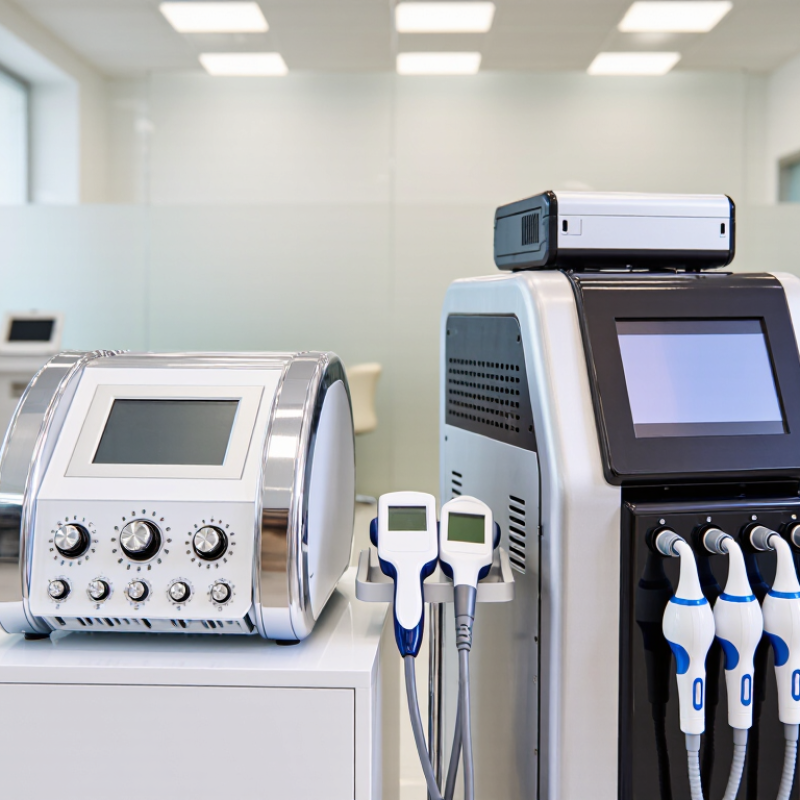
Commercial beauty machine prices often reflect engineering, not appearance. IPL systems emit broad light, commonly around 400–1,200 nm, while lasers deliver narrower bands at 755, 810, or 1,064 nm. The wavelength changes tissue absorption, treatment depth, cooling needs, and safety controls.
A 755 nm laser targets melanin strongly and suits selected hair-removal applications. An 810 nm diode wavelength usually offers deeper penetration with moderate melanin absorption.
The 1,064 nm wavelength penetrates deeper and is often chosen for darker skin risk management.
Technical reviews in Lasers in Medical Science describe these wavelength differences as major factors in fluence, pulse duration, and cooling design. They also show that IPL requires filters and broader optical control, not simply a stronger lamp.
Published market data adds another layer. Grand View Research reported continued growth in the medical aesthetics equipment market through 2023, driven by demand for multifunctional systems. However, market reports often group IPL and lasers together, making price comparisons imperfect. The U.S. FDA’s device-clearing records also show varied configurations, including different spot sizes, pulse modes, and cooling systems. These details affect manufacturing and maintenance costs.
A low-priced unit may look efficient on paper. I remain cautious. Lower cost can mean fewer calibrated handpieces, weaker cooling, or limited service support. Clinical performance depends on operator training too, not wavelength alone. That part is easy to underestimate.
Why Does the Price of Commercial Beauty Machines Vary?
Safety compliance is a major reason commercial beauty machines have different prices. IEC 60601-1 evaluates electrical safety, insulation, leakage current, and protection against shocks. Meeting these requirements requires engineering reviews, laboratory testing, and repeated design adjustments. Those costs become part of the equipment price.
ISO 13485 focuses on the manufacturer’s quality management system. It requires controlled production, traceable records, supplier checks, and documented corrective actions. This process can feel slow, but it helps reduce inconsistent output between machines. FDA 510(k) clearance is different. It generally shows substantial equivalence to a legally marketed device, rather than proving every performance claim. The submission requires technical evidence, testing records, and careful documentation. Not every beauty machine needs this pathway. Intended use matters.
Tips: Ask for current certificates, test reports, and the device’s exact intended use. Check whether documents identify the same model and manufacturer. Ask how often electrical safety tests are repeated. A polished certificate is not enough. I have seen buyers focus on treatment power while ignoring maintenance records and operator training. That can be an expensive mistake. Certification also does not guarantee perfect results. Installation quality, calibration, skin assessment, and staff judgment still matter. Some lower-priced machines may be suitable, but unclear documentation deserves careful questioning.
Certification is one of several factors affecting the price of a commercial beauty machine. The actual impact depends on the device design, intended use, target market, production volume, and required evidence.
| Certification or Cost Driver | What It Covers | Typical Scope | Common Cost Components | Indicative Planning Range* | Typical Time Impact | How It Can Affect Product Price |
|---|---|---|---|---|---|---|
| IEC 60601-1 | Basic safety and essential performance of medical electrical equipment, including protection against electric shock, mechanical hazards, excessive temperature, and certain abnormal operating conditions. | Electrical and electronic equipment that is marketed for medical purposes or falls within the applicable medical-device framework. | Electrical safety testing, leakage-current testing, insulation and grounding checks, mechanical inspection, risk-management documentation, sample preparation, and possible design revisions. | Approximately USD 10,000–50,000 for testing and related engineering work in a straightforward project. | About 2–6 months, depending on test failures, redesigns, documentation quality, and laboratory availability. | Raises development and compliance costs, especially when the product requires custom power supplies, cooling systems, high-voltage modules, lasers, or radio-frequency energy. |
| ISO 13485 | Quality-management-system requirements for organizations involved in the design, manufacture, installation, servicing, or distribution of medical devices. | Manufacturers and relevant suppliers that need controlled design, purchasing, production, complaint handling, corrective actions, and traceability processes. | Quality-system consulting, procedures and records, employee training, internal audits, certification audits, corrective actions, document control, supplier qualification, and ongoing surveillance audits. | Approximately USD 20,000–150,000 for initial implementation and certification, depending heavily on company size and system maturity. | About 6–18 months for implementation and certification; ongoing maintenance is required. | Increases fixed operating costs and quality-control expenses. These costs are usually allocated across the product portfolio and may be more visible in lower-volume machines. |
| FDA 510(k) | A U.S. Food and Drug Administration premarket notification pathway used to demonstrate that certain devices are substantially equivalent to a legally marketed predicate device. | Applicable medical devices that require 510(k) clearance. It is not automatically required for every cosmetic or aesthetic machine. | Regulatory strategy, predicate research, substantial-equivalence analysis, performance testing, biocompatibility assessment where applicable, software documentation, labeling, quality records, and FDA submission fees. | FDA user fees vary by fiscal year and business size; total project costs can range from tens of thousands to several hundred thousand U.S. dollars, depending on testing and submission complexity. | Often several months to more than one year, depending on submission quality, review questions, testing requirements, and the device category. | Can substantially increase the development cost of products intended for medical claims in the United States. The cost is normally reflected in the final price and future regulatory maintenance. |
| Intended Use and Claims | The stated purpose, treatment claims, target anatomy, and expected clinical effect can determine whether a product is treated as a medical device rather than a general cosmetic or wellness product. | All commercial beauty equipment, especially products making claims about disease treatment, tissue modification, pain reduction, or therapeutic outcomes. | Regulatory classification review, claim substantiation, clinical or performance evidence, label review, advertising controls, and possible additional testing. | No universal fee; regulatory and evidence costs can increase from a small documentation project to a major clinical or performance program. | Several weeks to more than one year, depending on the claims and evidence required. | Two machines with similar hardware can have very different prices when one is sold for cosmetic appearance enhancement and the other makes medical or therapeutic claims. |
| Energy Source and Technology | The type and power of energy delivered to the user or tissue, such as light, laser, radio frequency, ultrasound, electrical stimulation, or cooling. | Machines using high-voltage circuits, optical energy, heat, acoustic energy, vacuum, or electrical stimulation. | Specialized safety testing, optical measurements, electromagnetic compatibility testing, thermal analysis, shielding, interlocks, sensors, calibration equipment, and protective accessories. | Testing and engineering costs commonly increase as output power, treatment complexity, and hazard potential increase. | Typically adds several weeks to several months to development and verification. | Higher-risk energy systems generally require more sensors, control software, protective features, and validation, increasing both manufacturing and compliance costs. |
| Electromagnetic Compatibility | Controls whether the machine emits or is affected by electromagnetic interference during normal operation. | Most electronic commercial equipment; requirements become especially important for medical electrical equipment and devices used near other electronics. | Emissions testing, immunity testing, shielding, filtering, cable design, grounding, software updates, and repeat testing after modifications. | Approximately USD 5,000–25,000 for a basic test program, with additional costs if redesign and retesting are needed. | About 2–8 weeks for testing; longer if failures require hardware changes. | More robust electromagnetic protection can increase the cost of power supplies, circuit boards, enclosures, and cables. |
| Biocompatibility and Materials | Assesses whether patient-contacting materials are suitable for their type and duration of contact. | Applicators, probes, electrodes, cooling plates, handpieces, straps, gels, and other components that contact skin or may contact damaged skin. | Material characterization, biological evaluation, chemical analysis, irritation or sensitization testing, supplier documentation, and material-change control. | Approximately USD 3,000–30,000 or more, depending on contact type, duration, materials, and test strategy. | About 1–6 months, depending on the number of materials and required tests. | Specialized medical-grade materials and controlled suppliers may cost more than general-purpose alternatives but can reduce safety and compliance risk. |
| Software and Cybersecurity | Addresses software performance, alarm behavior, access control, data integrity, update control, and cybersecurity risks where software is part of the device. | Machines with treatment planning, automatic energy control, user accounts, network connectivity, stored treatment records, or remote updates. | Software lifecycle documentation, verification and validation, hazard analysis, cybersecurity assessment, penetration testing where appropriate, version control, and update procedures. | Approximately USD 10,000–100,000 or more, depending on software complexity and connectivity. | About 2–12 months, with continuing maintenance throughout the product life cycle. | Connected and highly automated systems usually cost more than manually operated machines because they require additional development, validation, and post-market support. |
| Production Volume | Determines how fixed design, testing, tooling, quality, and regulatory expenses are distributed across individual units. | All commercial beauty machines, with the strongest effect on specialized or low-volume equipment. | Tooling, molds, engineering labor, certification testing, quality-system maintenance, inventory, training, and after-sales service infrastructure. | The same fixed compliance program can add hundreds or thousands of dollars per unit at low volume, but much less per unit at high volume. | Does not necessarily extend certification time, but it affects manufacturing readiness and supply-chain planning. | Low-volume professional machines generally have a higher per-unit price because fixed costs cannot be spread across many units. |
| After-Sales Compliance and Service | Includes maintenance, calibration, complaint handling, vigilance, corrective actions, spare parts, training, and controlled product changes. | Especially important for products sold as medical devices or machines requiring periodic calibration and professional operation. | Service documentation, technician training, calibration tools, replacement parts, field-safety monitoring, incident reporting, software maintenance, and records retention. | Ongoing annual costs may range from several thousand dollars for a small product line to much higher amounts for regulated, connected, or widely distributed equipment. | Continues throughout the commercial life of the product. | A higher purchase price may include technical support, warranty coverage, calibration, training, and regulatory maintenance rather than only hardware. |
Commercial beauty machines can differ greatly in price because their output and working life are not equal. Energy levels from 10 to 50 J/cm² may indicate different treatment capacities, but a higher number is not automatically better. Actual performance also depends on pulse stability, spot size, cooling, and operator control. A machine delivering consistent energy usually offers more practical value than one with impressive figures but unstable results.
Pulse lifespan matters just as much. Some professional systems are rated for 100,000 pulses or more, while others require earlier replacement of key components. High pulse counts can reduce operating interruptions, but they do not guarantee flawless performance. Heat, cleaning habits, treatment frequency, and maintenance affect real service life. I have seen specifications look excellent on paper, yet daily use revealed slower output and higher maintenance costs. That is an important limitation to consider.
Tips: Ask for verified energy measurements, pulse-life testing, and maintenance records. Check whether the stated 10–50 J/cm² range applies across all settings. Confirm what “100,000+ pulses” actually covers. Is it the lamp, handpiece, or full system? Compare cost per usable pulse, not only the purchase price. A lower-priced machine may become expensive if consumable parts fail early. Reliable training and clear technical support also protect long-term value. Small details matter.
Cooling systems, handpieces, and consumables often explain the biggest price differences between commercial beauty machines. A basic cooling circuit may use air flow, while advanced systems regulate temperature through sensors, pumps, and insulated lines. These parts increase manufacturing and service costs. They also affect treatment comfort and operating stability. That distinction matters. The ISAPS 2023 Global Survey recorded more than 19 million nonsurgical aesthetic procedures worldwide. Higher treatment volumes make reliable cooling more valuable, especially during busy clinic schedules. However, a larger cooling system is not automatically better. It may consume more power, require specialized maintenance, and increase downtime when one component fails.
Handpieces create another cost layer. Different wavelengths, contact surfaces, and cooling methods require separate engineering. A machine with several handpieces can support more treatment options, but unused attachments become expensive storage. Grand View Research estimated the global medical aesthetics market at approximately 19.4 billion dollars in 2023. That growth encourages flexible platforms, although flexibility can sometimes hide unnecessary complexity. Consumables add recurring costs after installation. Disposable tips, protective covers, conductive gels, filters, and replacement cartridges affect the real cost per treatment. Buyers should compare expected usage, replacement intervals, warranty coverage, and technician training. I would also question optimistic payback calculations. They often assume full appointment books and ignore calibration, cleaning time, and occasional consumable waste.
The sticker price of a commercial beauty machine rarely reveals its real cost. In a busy treatment room, training affects safety, speed, and consistency. A trained operator can set energy levels correctly and recognize unsuitable treatment conditions. This reduces avoidable interruptions and repeat sessions. It also protects client trust. Short training is not always enough. Ask for live instruction, written protocols, and competency checks. Hands-on practice matters.
Warranty terms can change the three-to-five-year ownership picture. A low-cost unit may exclude handpieces, cooling systems, software, or labor. Check coverage length, response times, shipping duties, and repair limits before signing. One failed handpiece can remove a treatment room from service for days. That lost revenue may exceed the original price difference. Read the exclusions twice. They are easy to miss.
Service quality matters after installation. Reliable support should provide diagnostics, maintenance schedules, replacement parts, and documented repair history. Compare annual servicing with energy use, consumables, calibration, and staff downtime. A simple spreadsheet can expose the cheaper machine as the costlier choice by year four. Still, estimates are imperfect. Usage varies, and technicians may face delays. Review supplier claims against service records, references, and contract language. Keep those records. They support accountable decisions.
Cooling systems, handpieces, and consumables often create the biggest cost differences. Basic airflow cooling is cheaper than sensor-controlled systems with pumps and insulated lines. Advanced parts may improve comfort, but they also need more maintenance. Bigger is not always better.
Not necessarily. A larger system may use more electricity and require specialized servicing. If one pump fails, the machine could remain unused for several days. Check cooling performance, repair access, energy use, and expected treatment volume.
Different wavelengths, contact surfaces, and cooling methods require separate engineering. Several handpieces can support more services. Unused attachments still occupy storage space and tie up money. Choose tools that match real bookings, not hopeful plans.
Common items include disposable tips, protective covers, conductive gels, filters, and replacement cartridges. Their cost continues after installation. Track usage per treatment and replacement intervals. Small items can quietly become expensive.
Proper training helps operators select suitable settings and recognize unsuitable treatment conditions. It can reduce interruptions, repeat sessions, and avoidable cleaning mistakes. Ask for live instruction, written protocols, and competency checks. Short training may not be enough.
Check whether the warranty covers handpieces, cooling systems, software, labor, and shipping. Also review response times, repair limits, and exclusions. One failed handpiece can remove a treatment room from service. Read the exclusions twice.
Request maintenance schedules, diagnostic procedures, replacement-part details, and documented repair records. Ask how quickly technicians respond to common failures. References and service histories may reveal more than sales claims. Keep every record.
Include energy use, consumables, calibration, maintenance, training, cleaning time, and staff downtime. A simple spreadsheet can expose a cheaper machine as more expensive by year four. Do not assume full appointment books. The estimate can still be wrong.
The price of commercial beauty machines varies because cost is closely linked to technology, safety, performance, and long-term support. IPL systems covering a broad 400–1,200 nm range may differ significantly from laser platforms using specific wavelengths such as 755, 810, or 1,064 nm. Output capability, often measured from 10 to 50 J/cm², and a lifespan exceeding 100,000 pulses can also influence both purchase price and overall value. When asking “what is the price range for commercial beauty machines,” buyers should evaluate more than the initial quotation.
Safety certification, including IEC 60601-1, ISO 13485, and applicable FDA 510(k) clearance, may raise manufacturing and compliance costs. Advanced cooling systems, specialized handpieces, and replaceable consumables add further expense. Finally, professional training, warranty coverage, technical service, and maintenance can strongly affect total ownership costs over three to five years. A lower upfront price may not always represent the most economical choice if operating efficiency, reliability, and after-sales support are limited.

OneSe Beauty